Archive for January, 2010:
Oh My Kami! Fujin
Those of you familiar with Mortal Kombat might have heard of today’s kami before, although the game version is quite different from the real one. This is Fujin (風神), the god of the winds. He’s said to be one of the oldest gods, present at the time of Creation when he opened up his bag of winds to clear the morning mists and fill the void between Earth and Heaven.
His appearance is that of a fearsome demon, and in Chinese mythology he and his buddy Raijin (we’ll meet him later) were evil demons who opposed Buddha, but after being defeated by his army, they join his side and have been working as gods since.
While the god of the winds has probably always been a part of Japanese mythology, the imagery we see of Fujin can be traced back to the ancient Greek god of the North Wind, Boreas (from whom we get the words boreal, aurora borealis, and Hyperborea). Boreas carried a magic cloak in which he carried the wind, and he was a very popular god. When Alexander the Great formed his empire, he brought Greek gods and imagery all the way to India’s doorstep, and the cultural reverberations were tremendous. The Greco-Bactrian culture that sprang up in present-day Afghanistan preserved those Greek images long after the dissolution of Alexander’s empire, and eventually merged them with Buddhist iconography, which traveled along the Silk Road to China and then Japan. Pretty cool, huh?
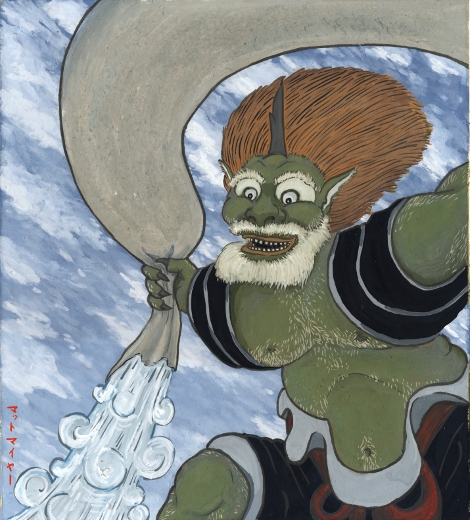
Fujin
I won’t be posting a kami tomorrow or the next day, as I will be traveling to Yokohama for a friend’s wedding. So have a nice weekend and Coming of Age Day (here in Japan), and when I get back I’ll post a new kami very soon. Maybe I’ll get some nice wedding photos too.
This print is available on my Etsy store. If you’re interested in buying the original, please email me. Thanks for reading!
Oh My Kami! The Seven Lucky Gods
Kami are Japanese gods and goddesses, but the concept is not quite the same as the Western concept of gods. It’s closer to the Chinese Buddhist tradition of gods, but not quite the same. Religion in Japan is a mixture of the native Japanese Shinto with Buddhism, with some Taoism and Confucianism thrown in the mix. While the Shinto concept of gods is vague and can encompass just about any kind of spirit, there are also many gods which are pretty clearly defined; especially the ones imported through Buddhism. And, unlike Western Buddhism which has no gods and was roughly derived from Tibetan Buddhism, Japanese Buddhism was important through China, after having been brought along the Silk Road from India and becoming intermingled with Hindu, Greek, and Chinese religions. So the origins of each god in Japan — there are said to be 8 million of them — are pretty unique (and quite fascinating — I’ve actually lost a lot of painting time by getting distracted tracing some of them through time and cultures to find their origins). I could talk probably about cultural anthropology for hours, so before I get off topic, I’ll move on to today’s painting.
Now it’s the Year of the Tiger, and while that means tiger symbols are ubiquitous over here (like my Byakko from the other week), there are a number of other traditional New Years icons that are uniquely Japanese. Since it’s still New Year’s season, I chose the Seven Lucky Gods (七福神, shichifukujin) to be the first in a series of Japanese deities. These characters are especially popular on New Year’s, but can be seen all over Japan, in little netsuke toys, street statues, at shrines and temples — they’re all over! If you’ve been to Japan, or even looked through photos, no doubt you’ve see images of at least one or two of them. Their origins are pretty diverse, as I mentioned above, coming over from Taoist and Buddhist deities in China, but in Japan they are recognized as the gods of fortune.

Shichifukujin
Hotei, the fat, shirtless one, is the god of abundance and good health. He is popular all over East Asia and is even popular in the US, where he is known as the Fat or Laughing Buddha.
Jurojin, with his long staff, is the god of longevity. He’s usually accompanied by a deer. This one was imported from Taoism. If you’re also an astronomy buff, you may be interested to know that he is the deification of Canopus, which you can see quite bright at night if you live anywhere south of LA.
Fukurokuju, with his awesomely long head, is a god of happiness, wealth, and longevity. He’s quite similar in appearance and ability to Jurojin, although hes’s the only one with the ability to raise the dead. In astronomy, he is Sigma Octantis, which hovers over Antarctica.
Bishamonten is the god of warriors and a punisher of evildoers. Usually in depictions of the Seven Lucky Gods, 6 of them are smiling, and he’s the one making a grumpy face. Evil never rests, I guess. He’s the Japanese version of Vasraivana, one of the Four Heavenly Kings of Buddhism.
Benzaiten, the only goddess in the bunch, is the goddess of knowledge, art, beauty, and especially music. She’s the Japanese version of the Hindu goddess Saraswati, who is often seen playing a sitar. In Japan she plays a biwa. In some places she’s called Benten, although according to Wikipedia that name actually refers to Lakshmi. Maybe the two were merged?
Daikokuten is the god of wealth, commerce, and trade. He carries a big hammer, which is officially known as the magical money mallet. You can find masks and images of him and his friend Ebisu in shops all over Japan. He’s the Japanese version of the Tibetan Mahakala, one of the forms of Lord Shiva. The Japanese version is much less scary.
Ebisu, the god of fishers and merchants, often carries a fishing pole or a sea bream. His name is sometimes spelled Yebisu, and you might recognize him from the beer of the same name (which also bears his likeness). Ebisu is a Japanese native, not an import, and his story is an excellent one. He was born Hiruko, which means leech child, and was born without arms or legs or bones. His parents were the god and goddess of creation, who apparently were not happy with what they created, so they cast him out to see as a baby. By his third birthday he had grown a skeleton, as well as new arms and legs, and he became the god Ebisu. As a god, he remains slightly crippled and deaf, but he’s still an awesome symbol of luck (understandably so). He’s also special because while the other 8 million gods are unavailable to answer your prayers on October 20th due to a big business meeting, Ebisu hangs around (he’s deaf and can’t hear the summons).
All seven of them are frequently shown riding a boat with the kanji for luck on it. There are a few different kanji for luck, so presumably they change the sail every now and then.
This print is available on my Etsy store. If you’re interested in buying the original, please email me. Thanks for reading!


