Internet Sales are the Same Everywhere…

We’re finally making the move this weekend, though we’ve been sending boxes in loads every weekend so it feels like it’s been going on for almost a month now. Today we called to set up internet service at the new apartment, and had some trouble.

Japan is a pretty high-tech country, and in recent surveys it’s been shown to be leaps and bounds ahead of the US in internet connectivity (of course when you have half the population of the US crammed into an island the size of California, with only 18% habitable land area, it makes it easier to connect everyone). Bandwidth costs here are also pennies to the dollar compared with the US — the last time I purchased internet service was almost 3 years ago, and I ended up paying $60 a month for speeds 120 times faster than what people in the US were paying $150 a month for. So I admit that even I fell into the false assumption that people in Japan should know what they’re talking about when it comes to net service.

We had a very long conversation on the phone about prices and setting it up and all, and eventually they asked me what OS I use. I should’ve just lied and said Windows, but I managed to say Ubuntu without thinking, and immediately regretted that mistake. The sales lady didn’t know what that was, and said that they don’t support it, and I should buy their tech support program for an extra monthly fee. I told her it was okay and I knew what I was doing, but she kept insisting that their internet service won’t work on my PC. I tried to explain that service is service, and it doesn’t matter what the PC is running, but then tried to explain that their cables won’t work with non-Windows computers and I should buy their tech support service. Later she asked me how many machines I would be setting up, and I said two, but she told me that was also impossible without their tech support service and a Windows PC. At this point there really wasn’t anything more I could explain to her… I said it was okay and I didn’t need the tech support, and she told me that they will have in investigate the building to see if they’ll be able to install the internet service or not. This will take approximately 3 weeks.

It seems that telecommunication company incompetence is a global, cross-cultural phenomenon.

Dried Bat

I just wanted to post and say that no, I’m not dead. I’m just very busy packing boxes and driving them to another city, so I haven’t had much time to post anything lately. This room is pretty empty now — it’s just me and my computer and my parakeet. We’ll finish the move this weekend, and I’m looking forward to getting this done with!

One interesting discovery occurred last weekend when my wife and I were carrying our refrigerator and other heavy things up to the 3rd story of the apartment building (in this crazy heat, too, which wasn’t fun!). There was a huge pile of animal poo on one of the staircases, which I thought must belong to mice or something like that, but it was in a curious location — only on one of the landings. Then I saw what looked like a black, dried up leaf on the stairs. Only on closer inspection did I realize it was a bat, mummified from the heat. (The turds obviously turned out to be bat droppings.) Even weirder, I found another mummified bat on the next flight up! They were basically your average vesper bat, probably Pipistrellus abramus, but since they were so tiny I wonder if they were babies that slipped off the wall and died when they hit the stairs.

Mummified Bat #1

Mummified Bat #1

Mummified Bat #2

Mummified Bat #2

I had a discussion with a friend about this and she was totally shocked. Not because there were mummified bats on my staircase, mind you, but because there were bats at all. She’s lived here for her whole life and never once knew there were bats in Japan!

Unfortunately, due to the move, I probably won’t be posting any new artwork this week or next, as I will be busy with other things. I am working on a new image for 100 Famous Views of Philadelphia (it’s been a while since I’ve added to that series) and I will do another small chicken painting for a contest shortly after the move is completed.

Reconstructing Fukui Castle

I love history. When my mind wanders, one of the things I constantly go back to is imagining different worlds if history had been different. You know, like if you could go back in time and give Julius Caesar a modern chemistry textbook, or warn the American Indians about the crap the Europeans are trying to pull. Japan has an amazing and rich history, and riding my bike through town usually ends up with me daydreaming about different time periods here (a little dangerous perhaps). Particularly here in Fukui prefecture, where the modern world has just barely taken a foothold, there are so many places where the land is untouched by foreign influence or the modern global culture. It’s easy to get lost in one’s imagination.

Historically, Fukui was a very important military and cultural center of Japan for many centuries. After the feudal period its power waned considerably, but in its heyday it was one of the top population centers in Japan. Sadly, though, that history is mostly buried here. All of the castles have been leveled and paved over, the aqueducts filled in and turned into streets and real estate, and most of it has been forgotten even by the residents.

Fukui castle is one of the sites that almost brings tears to my eyes when I think how much history has been squandered. Currently the prefectural capital and largest city in the prefecture, Fukui used to be a rural swampland called Kitanosho. In the late 1500′s a castle was built here, and soon afterwards war came. The first castle was burnt down after 8 short years, and in 1606 a new castle was built at a nearby site. The whole city was designed and developed into a paragon of a castle town. Moats and canals were dug all over town separating it into many districts, walls and gates were erected all over for defense, and walled samurai towns sprung up. Looking at the old maps of Fukui city, it looks like it must have been completely impregnable.

Although the town was never taken after that, a fire destroyed the main keep in 1669 and it was never rebuilt. The innermost walls remained, as did the noble’s houses on the castle grounds, though, and it continued to be an important castle town until the Meiji Restoration. Sadly, the remaining walls and palaces were burned down when Fukui was firebombed in World War 2. A few years after the city was burnt to the ground by bombers, a huge earthquake struck and re-leveled the city once again. The stone walls of the castle still bear the marks of that earthquake. During the second reconstruction, the cityscape was changed and it lost its identity as a castle town. The aqueducts and moats were paved over with cement and a lot of important cultural heritage was lost. While other cities on Japan reconstructed their castles and turned them into parks and tourism centers, Fukui erased its past, even going so far as to build a hideous government building on top of the remains of the castle palace.

Today the city is expanding, and as it grows and new construction takes place, workers are constantly finding old walls and remnants of the castle town. Thankfully, some work has been done to restore these artifacts when they have been found, and there are plaques scattered about the city wherever a historical remnant has been uncovered. Whenever I run into one of these I stop for a while and try to picture what the city could have looked like if the people in charge of reconstructing the city had had a little more foresight (and hindsight) about preserving their history.

A few years ago, a minor reconstruction at the castle grounds took place. One of the rotting wooden footbridges was reconstructed into its original, beautiful form. On the day it opened, I went to visit it, and it was just superb. Even though it was only a bridge, the smell of the new timber and the authentic reconstruction of the ancient building stirred my imagination. I decided I wanted to paint a view of what the town might look like if the castle had never burned down, and if it had been preserved properly.

I started this painting two years ago and got about halfway done when I hit a big roadblock: I couldn’t find any reference of what the castle looked like! I thought about making up a new facade for the castle based on the other castles I have visited, but that just didn’t seem right. Each castle is unique, and that wouldn’t be fair to Fukui castle or the castle I would have copied. I had to put the painting on hold until I could accurately reconstruct it.

For the past two years I have visited libraries, history museums, and done countless image searches trying to build up a database of images I could use to reconstruct the castle. Every now and then I would find a goldmine. One store was selling postcards with pre-WW2 photographs of the town. I could finally reconstruct the outer walls! At another store I found a few old woodblock prints with images of the castle, printed back when the castle was still around! But sadly the perspective was way off and it was hard to get an accurate measuring from them. I did a lot of research and discovered a whole lot about Fukui’s history as well — not just the castle. It was like unfolding a mystery that was hidden all around me; in the street names, the rivers, under the streets, and the property lines remnants of the old castle town were still evident. From one of the paintings, I learned that one of my friend’s apartments was actually built right on top of one of the old gateways into the city!

Fukui Castle scale model

A scale model of Fukui Castle I stumbled upon while climbing Mt. Asuwa. Who hides such a beautiful piece of artwork in a field behind a parking lot on top of a mountain??

Old photo of Fukui Castle

A pre-war photo showing the walls of Fukui castle

Old photos of Fukui City

Photos showing various shots of old Fukui
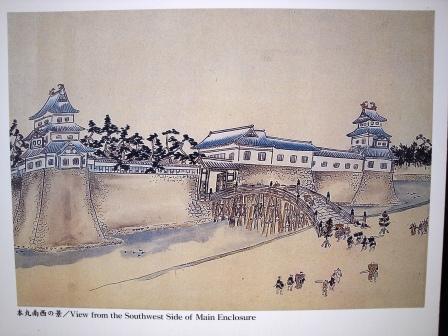
An old painting of Fukui castle

A very old painting showing the castle before it burned down

A diagram of Fukui Castle

A diagram of the main keep located on a plaque outside of the castle ruins

3D digital image of Fukui Castle

3D digital recreation of Fukui Castle

Finally, I discovered a website that created some 3D images of old castles, and lo and behold, they recreated a shot of Fukui castle! It was the final bit of reference I needed to be able to reconstruct what the castle might have looked like. I spent the better part of this week putting together my references and sitting down to finish this two-year-old painting, and here is the result. The only part I was unable to faithfully recreate is the gatehouse beyond the bridge, as none of the references I found were able to give me a good image of it. So I did my best to recreate what it may have looked like, based on other castles’ gatehouses.
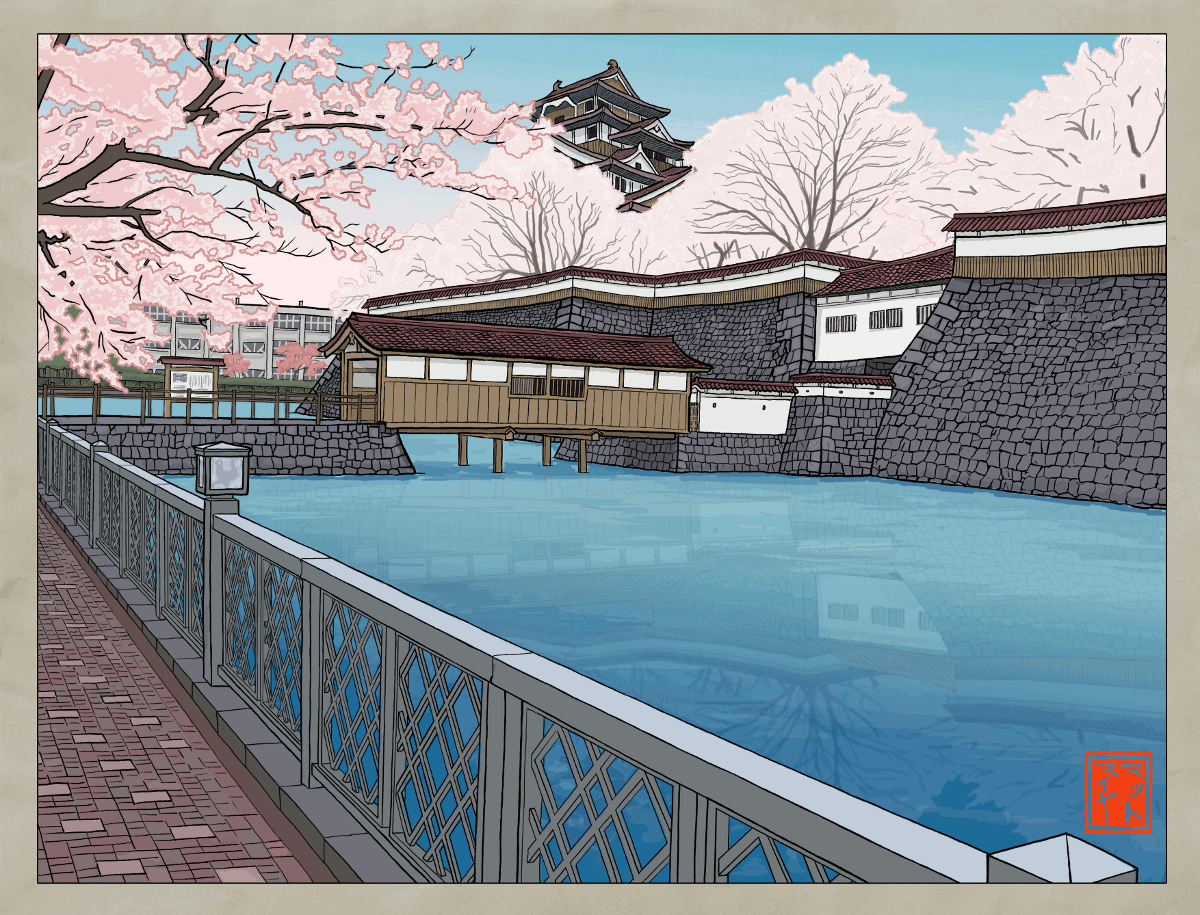
Fukui Castle, if it were still around today

Fukui castle, seen from the south, during cherry blossom season (click for a larger version)

In one week, I will be moving back to Echizen city after spending a year here in Fukui. Even though Echizen is only 30 minutes away from Fukui, I’m especially happy that I was able to finish this painting now, rather than later. I feel like I can present it now, saying thank you to the city that has struck my imagination so strongly. (After all, after I return to Echizen I’m going to resume obsessing over that city’s own rich, forgotten history.)
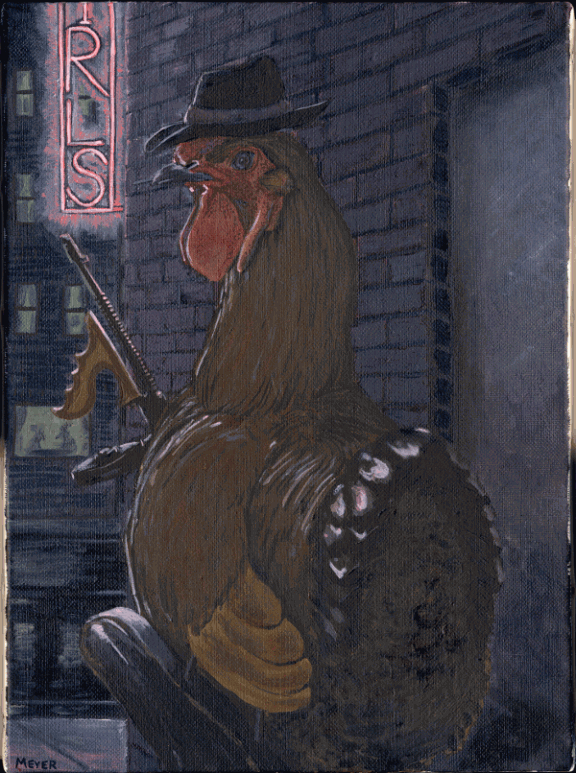
Whatcha Lookin’ At?

The Gangster

The Gangster

It’s been a busy month, what with studying for the JLPT, organizing things for the move, such as shutting off the utilities and turning them on at the new apartment, and packing things up. I really haven’t had that much time to paint (hopefully I can make up for that with ample painting time starting next month). I did manage to get one done this month though: a new chicken, The Gangster!

I recently ran a Call of Cthulhu game set in 1920′s Boston and NYC, and the final game had a pretty fun car chase/shoot out with a bunch of cultists/bootleggers/gangsters. I had such vivid images in my head after that I really wanted to paint a gangster, so I sketched out this chicken one day and spent this week painting it. I didn’t use any lemon yellow this time so it didn’t have any trouble drying. On the other hand, though, as it’s a pretty dark painting, it was really hard to get the colors and values right in the scan. They’re pretty close to the real image, though the bricks on the wall are just a bit bluer than in the real painting.

3 Years in Japan

Today marks the end of my 3rd year in Japan and the start of my 4th. Wow! It’s hard to believe I’m working on my 4th year now. And it’s been one year since I stopped teaching English full time and moved to Fukui city. Then again I’ll be moving back to Takefu in a couple of weeks… And this has been one year of painting nearly full time for me. And although I haven’t gotten any big breaks or major projects yet, I feel like I’ve noticeably improved as a painter. And I’ve had a little bit of success as a freelance painter, even if nothing big. Moving to Takefu next month, I hope I can improve on that. I’ll finally have a studio and a place to hold my art (rather than stacking it in a pile in the center of this tiny one-room apartment), and I’m planning to try starting up a small painting circle and teaching some lessons.

Time certainly flies, doesn’t it! 光陰矢のごとし。

The 4th of July in Japan

Yes, it’s a little late, especially considering I just did a Tanabata post, but it would be wrong of me to go without mentioning the 4th of July.

When I was  a kid in 4th grade, my family took a trip to the UK during July. One of the big things I remember from that trip was that it was the first 4th of July I would spend outside of the US, and I feared I would be somewhat less American for doing so. But the really interesting thing was that British radio spent the whole day talking about the 4th of July and interviewing Americans about what they do on the holiday — even playing patriotic American songs. I was fascinated by the irony considering the origin of the holiday.

July 4th in Japan is nothing like that.

Seriously, the day goes by completely unnoticed, as one would expect in any country that is not the US (or perhaps Canada or the UK). And of course there’s nothing wrong with that at all. For me, though, I spent my 4th of July mostly in Kanazawa, taking the Japanese Language Proficiency Test (N2 level, which is judged to be standard business-communicative level).

You may remember I took the test back in December for the first time. Back then I didn’t have much of an expectation, and I was just doing it for fun to see if i could. I had taken a sample test of Level 3 (which is lower than 2, for those of you who don’t know) and passed it easily, so I thought 2 was the right level to try. I failed that test by a small margin, but I pretty much met my expectations — I passed the listening and grammar sections with flying colors and bombed on the kanji/reading section. This made perfect sense to me since I speak Japanese a lot but rarely ever read or write in it.

This time I thought I would be a bit more prepared. I bought a pair of kanji textbooks for N2 level and studied them front-to-back until I knew about 90% of them perfectly. So I had some confidence that I would be able to close the small gap that failed me the last time, even if some of the kanji were still too difficult for me to read.

Boy was I wrong.

Again, the listening and grammar sections were a piece of cake, but the reading/kanji sections… WTF! A good 60% of them I completely could not read, and I would say that upwards of 40% of the kanji there I had never even seen before, let alone read them (as an artist I have a very strong visual memory, so I can spot the difference between a word I simply can’t remember and a word I’ve never even seen). The first time I failed the test I didn’t feel frustrated at all, because I had no expectations and I thought I would have a lot of trouble. This time was ridiculous and I felt pretty unhappy having spent so much time studying only to have it mean absolutely nothing.

Now, I don’t know for sure that I failed. It’s possible I closed the point margin after all by some close number. However I don’t have any confidence that I passed this time. Had I simply not remembered the words I saw I might have felt foolish at my own inability, but this time I felt absolutely cheated. All of that time — and two entire textbooks — was a totally waste in regards to preparing for the test. Granted I learned a lot of good kanji, and it will help my Japanese skills… but the point was to also pass the test, and I don’t know if the Level 2 book publishers dropped the ball on selecting reasonable kanji or if the testmakers just made the test too difficult… but the only feeling worse than being unable to do something is feeling like you were deceived into being unable to do something.

After the test, and with me pretty unhappy with the huge disparity between the easiness of the listening section and the difficulty of the reading section, my wife and I drove back to Takefu to celebrate the 4th as best as we could in Japan. We bought some hamburger meat and hot dogs, and found the largest bun-like bread we could find (pitifully small butter rolls) and grilled them up on a grill totally not made for burgers. They turned out delicious by some stroke of luck, though, and we had a great dinner. Afterwards we shot off cheap fireworks and listened to the US National Anthem on Youtube. It ended up being a pretty good day despite everything.

Burgers

Teeny tiny grill

A Feast

Not a bad setup for a Japanese Fourth of July!

Happy Tanabata

Summer has officially begun in Japan, and although you folks in the US are melting in your shoes in this heat wave, here we’ve been having fairly cool weather (continuing the trend of the unseasonably long and cold winter we had, and the very short and very cold spring). I was walking around the rice paddies tonight in the cool humid air and I saw some kids setting off fireworks. I thought about the 4th of July for a minute, and then remembered today is July 7th, or Tanabata.

Tanabata

Tanabata Ukiyoe

Tanabata is a star festival derived from the Chinese festival Qi Xi. In the days when Japan used the Chinese calendar, the 7th day of the 7th month generally fell in August around Obon, and so over the years this holiday has mixed a number of Chinese and native Japanese traditions together. It’s based on the legend of the Princess and the Cowherd. It tells of Princess Orihime, daughter of the Sky King, who lived on the banks of the Milky Way. She was such a skilled weaver that she was always busy with work — too busy to even fall in love. This made her very sad, and so her father arranged her to meet Hikoboshi, the cow-herder, who lived on the other side of the Milky Way (in Japanese the Milky Way is called “Heaven’s River”). They fell in love instantly and got married. However, once they were married, Princess Orihime would never weave again, and her father became so angry that he separated them across the Milky Way from each other and forbade them ever to meet. She cried and she cried, and eventually the Sky King promised her that if she worked hard weaving all year, on the 7th day of the 7th month he would allow them to meet each year. On the first Tanabata, there was no bridge across the Milky Way, so Orihime and Hikoboshi couldn’t meet. Again Orihime cried and cried, and eventually a flock of magpies came and, linking their wings together, created a bridge for her to cross and meet her lover.

Tanabata is celebrated here particularly by young (and single) people. It’s a lovers’ holiday, and people write their wishes on colored paper and hang them on bamboo trees. No doubt if you’re in Japan you’ve seen many of these trees everywhere you go — in department stores, outside of shops, at stations, schools, and so on. A lot of young people — especially young girls — wear summer kimonos called yukatas, which are light, made of cotton, and very beautiful in the summer night city lights.

Finally, if you’re an astronomy nerd like I am, you might be interested in knowing that Orihime is Vega and Hikoboshi is Altair. They’re two of the easiest stars to pick out at night. Even on a hazy night like tonight when the Milky Way isn’t visible, I can see both of them (in fact, I can see both of them, Venus, and not much else tonight thanks to the haze and the light pollution mixing). They straddle the Milky Way, and are the 5th and 12th brightest stars in the night sky, so there’s a good chance you can find them almost any night this season.

Vega

Vega and Sol

Thanks to the peculiar rotation of our planet, Vega was Earth’s northern pole star in around 12,000 BCE and will again be so in 13,727 CE. It is 25 light years from Earth, about 1/10 the age of our sun, more than twice the mass, and aging much faster than our sun (so that both stars are now middle aged). Vega rotates so quickly that it is pronouncedly bulging and rotating so rapidly that it almost tears itself apart. Vega also has a dust-belt like our own solar system’s Kuiper belt, and is thought to have at least one larger-than-Jupiter-sized planet. Vega has been important in every human culture that has ever gazed up at the stars, not just East Asian ones.

Altair

Altair and Sol

Altair is only 16.8 light years from Earth and is not quite twice as big as our own sun. Like Vega, it rotates at a ridiculously high speed — so fast that the equator is significantly dimmer than the poles and the planet has a very squashed shape. Altair is one of only a handful of stars (including our own sun) to have been directly imaged by humans, so we actually know a bit of what its surface looks like, rather than just knowing the star as a point of light. Altair has also played an important part in many human mythologies. The Altair system was even the setting for the cheesy Sci-Fi classic Forbidden planet. And in astrology (that parasitic profession that plays off human ignorance) Altair is connected with dangerous reptiles.

So go outside tonight if you haven’t already, take a look up at Orhime and Hikoboshi, and wish them luck and love!

Orihime and Hikoboshi

Can you spot the star crossed lovers?