Another Great Day for Sketching

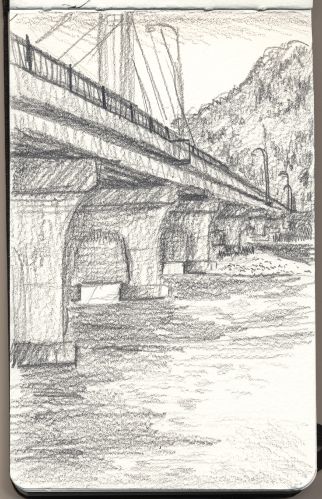
The bridge to Takefu

Bandai-bashi over the Hino River

I took my art class to the river again today to sketch birds and mountains. It was beautifully overcast — the perfect amount of light to make the river glow an emerald blue — with a cool breeze that brought the wonderful smells of flowers, wet grass, and burnt cypress along with it.

One of my students recognized the mysterious white bird that I posted about last week. She said its a sekirei, and checking my Japanese-English dictionary that turns out to be a wagtail. What an appropriate name!

Well, according to Wikipedia, its name is actually a mistranslation of its Latin name motacilla, but “wag-tail” is far more fitting than the Latin “little mover” due to the very distinctive tail bobbing it does every time it moves.

Judging by the distinctive eye stripe I would guess it is a Japanese pied wagtail: Motacilla albis lugens (http://en.wikipedia.org/wiki/White_Wagtail)

I had been wondering what they were ever since I came here, as I had never seen them in North America. Unfortunately people rarely know the answers to the weird questions I ask (like “what species of bird is that?”) but today I was just lucky.

Springtime Sketching

May is one of the best months of all, especially in Japan. In fact, it is in the running with October for my favorite month of all. Nearly every day has been sunny and warm, with a cool breeze, cool nights, and a pleasant breeze blowing all day long. The wind carries the smell of flowers and timber from the nearby mills, and the songs of frogs and birds carry on all day long.

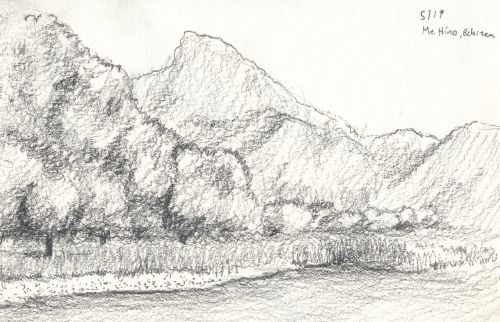
Yesterday I took my art class to the Hino River in the center of town for sketching — it’s one of my favorite places to sketch here. We sat under the bridge in the shade, surrounding by darting swallows, catching bugs and feeding them to their chicks. The sound of the water and the sweet breeze made it a wonderful day for sketching outside. In between monitoring class I was able to jot down this little pencil sketch in my moleskine:

Mt. Hino

Mt. Hino from Takefu

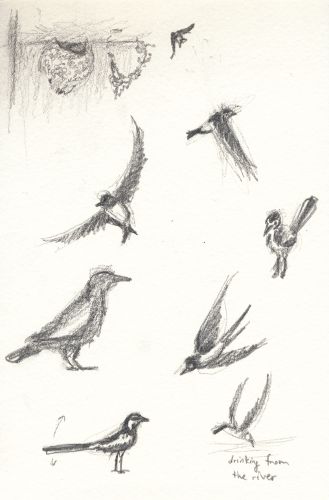
After sketching the mountain, we spent the rest of the class watching the birds dart about. Swallows have the most amazing movement which was hard to capture, but I was about to do a couple of 10-second gesture drawings of them. These short, tiny bird sketches are refreshing in comparison to the relatively longer landscapes. If you don’t finish them in under 10 to 15 seconds you lose all of the energy and the end result looks lifeless, so you are forced to just take a snapshot with your eyes and then transfer all of that energy onto the paper in just a few strokes. You can see the result below.

Birds

various birds

By the river, tons of other birds stop by for drinks and baths — crows, kites, herons, storks, pheasants, sparrows, and more. There is this one black and white bird that I see around here a lot. I have no idea what it is, but it is very beautiful and its tail bobs up and down in the most amusing manner whenever it stops running. It reminds me of the plovers of the Atlantic coast, but it’s a bit smaller and I don’t think it’s a shore bird.

Tenjin-sama

Earlier this year I was commissioned to do a kakejiku — a Japanese hanging wall scroll — of Tenjin-sama, the Shinto kami (god) of scholarship. I did a little post on him back then, but I haven’t been able to show the work because these kind of scrolls take a long time to frame (over a month), and I didn’t want to upload any images until the owner had received the finished piece. The scroll is long — taller than I am — and the image itself is about 4 feet high. These kind of scrolls go in an alcove called a tokonoma, which is found in Japanese-style rooms with tatami mat floors. Kakejiku are often changed with the seasons, so families that can afford it often have many different ones that they can rotate in and out depending on the time of year.

Tenjin-sama was an interesting project for me to do. There are lots of symbols and things to take into consideration in this kind of artwork, so I had to do a lot of research before putting my brush to (a very very large piece of) paper. You can read more about him on his Wikipedia page, but the long and short of it is that a nobleman and poet named Sugawara no Michizane fell out of favor with the emperor and was exiled to far-away Kyushu. He died while still in exile, and it is said that his spirit turned into a vengeful ghost, or an onryo. Immediately after his death, the capital was struck by a number of disasters, and the court magicians and priests ascribed the storms and fires to the angry ghost of Sugawara. In order to placate his spirit, they enshrined him as a god, calling him Tenjin. He was ranked very high as a god and his shrine was supported directly by the government, so he became quite popular. Tenjin was worshipped first as a sky deity and bringer of disasters, but eventually this gave way to his status as a scholar and a poet during life, and he became a popular kami of education and scholarship. He is prayed to by parents and students during exam periods and so on.

The trees in the painting behind him are pine, bamboo, and plum. Pine and bamboo have auspicious meanings attached to them, and are common motifs in scrolls, while the plum was Sugawara’s favorite flower. His shrines are commonly decorated with plum trees, and there is a famous poem he wrote in exile in which he laments his favorite plum tree which he had to leave behind in the capital.

Obviously the picture was too large to scan, so I had to stitch a few digital photos together to make this composite. As a result, the color isn’t perfect, but I think it comes close and can give you a good idea of what the finished, full size piece looks like.

Tenjin-sama

Tenjin-sama wall scroll