The Willow Spirit
from Tamasudare
During the Bunmei era (1469–87), a retainer named Iwaki Shichirō Tomotada served under Hatakeyama Yoshimune, the governor of Noto Province. From childhood, he displayed exceptional intelligence and was renowned for his poetry and prose, excelling in both Japanese and Chinese-style poetry. He was a handsome young man, not yet twenty years old. Yoshimune cherished and doted on this Tomotada. His birthplace was Echizen Province, and his mother remained in their hometown alone, but the turmoil of the Ōnin War made the land too unsafe for him to return.
One year, acting on the shōgun Ashikaga’s orders, Yoshimune betrayed the Western Army’s Yamana clan and allied with the Eastern Army’s Hosokawa clan, opening the route to the northern provinces. Since the Yamana had a castle at Somayama in Echizen Province, Yoshimune made camp at the mountain’s base and was biding his time before assaulting it.
Since his mother’s home was nearby, Tomotada seized the opportunity and secretly rode alone on horseback to visit her. It was the beginning of the first month; snow blanketed the mountains, the cold wind pierced his skin, and his horse struggled to keep its footing, making it difficult to proceed. Spotting smoke rising from a dilapidated hut beside the road, he brought his horse near.
An elderly couple and their seventeen- or eighteen-year-old daughter were inside, dozing off as they warmed themselves by a fire. The daughter’s hair hung loose and disheveled like mugwort, and her dirty robes were too short; yet the corners of her eyes were as beautiful as flowers, and her snowy skin was pure, gently captivating all who saw her. Truly, Tomotada never knew such fair people could be found deep in the mountains. It seemed almost as though this were the dwelling of an immortal.
The elderly couple looked at Tomotada and warmly greeted him, saying, “Oh, you poor young man. Are you lost and alone in these mountains? The snow is piling up, and the cold wind is becoming unbearable. Come closer to the fire and warm yourself.”
Tomotada gladly accepted, pleading weakly, “The sun has already set and the snow continues to pile up. Please allow me to spend the night here.”
The old man replied, “In our remote mountain dwelling, we have little with which to offer proper hospitality. Still, as you travel under falling snow, what reason could there be not to shelter you for the night?” He unsaddled the horse, set up sliding screens to create a private space, and attended Tomotada with care.
The daughter adorned herself and changed her clothes, then she lifted the partitioning curtain to look toward Tomotada. She was even more exquisite than when he first saw her; her beauty was bewitching.
“This is a mountain custom. Warm up some cloudy sake over the fire to ward off the night’s chill,” said the host as he passed a cup around. Without thinking, Tomotada offered the sake cup to the girl. The couple laughed and responded, “She is but a lowly girl raised in the mountains, and not worthy of your esteemed heart; but to dispel the gloom of your lodging on this journey, please offer her your cup.”
Blushing, the girl accepted the cup. Tomotada sensed something unusual about her and thought, “I shall test her discreetly.” Casually, he recited:
“Thinking it the flower
I had been seeking,
I lingered until nightfall.
Dawn has not yet broken;
why then, does it glow crimson?”
The girl replied in verse:
“Could I but wrap
the faint glow of the rising sun
in my sleeves,
then surely tomorrow
you would stay here again.”
Tomotada thought, “She immediately composed a response in verse—surely she is no ordinary person.” He said, “I have no wife whom I cherish above all. Please, grant me your daughter.”
The couple replied, “We are people of such humble standing. How could we presume to offer you our daughter? Still, if only for a time, please let her bring you some comfort.”
The daughter also replied, “I entrust myself to you, so please do with me as you will,” and they spent the night together.
When dawn broke, the storm had calmed and the sky was clear. Tomotada said, “I must now take my leave. Please think of this as a token from your daughter until you meet again,” and he took a bundle of gold from his robe and gave it to the couple.
But the old man said, “This is entirely unwarranted. It is we who should at least send her off properly, with fine garments, but we are poor—what can we do? My wife and I can manage somehow, so please take our daughter with you now,” and he absolutely refused to accept the money.
So Tomotada, having no other choice, set the girl upon his horse, took leave of the couple, and returned to camp.
Afterwards, the Yamana and Hosokawa forces were disbanded. Yoshimune proceeded to the capital and made camp at Tōji. Tomotada secretly took his wife along and kept her by his side, but somehow, Hosokawa Masamoto, a member of his lord’s family, laid eyes upon her and was instantly smitten.
Masamoto was so enamored with her that he sent his retainers to steal her away under cover of night. Thereafter, he lavished extraordinary affection upon her. Although Tomotada was filled with bitterness, he could not oppose the nobleman, and sank deeper into despair with each passing day.
One day, overcome with longing, he secretly tracked down an intermediary and sent a letter to his wife. Hidden within the letter were these lines:
“The sons of nobles chase after her;
Luzhu’s tears fall upon her silk handkerchief.
Once entered, a lord’s gate is deep as the sea—
From this day on, your lover is but a stranger.”
Somehow, this Chinese poem came to Masamoto’s attention, and he sent word to his retainers: “Summon Tomotada to me in secret; I have something to say to him.”
Tomotada, having no idea what this might mean, thought, “Surely my marriage to my wife must have been discovered. He must fear the depth of my resentment, and he means to bring me in and kill me. If I must die, might I get to see my wife one last time? And if I get the chance, I shall at least strike a single blow of vengeance.” With these thoughts weighing upon him, he went to Masamoto’s quarters.
As soon as Masamoto appeared, he took Tomotada’s hand and said, “The verse ‘Once entered, a lord’s gate is deep as the sea’—was that composed by you? Truly it moved me deeply!” His eyes brimmed with tears.
Then he immediately summoned the woman and returned her to Tomotada, even presenting him with a variety of gifts. He showed extraordinary kindness. This, too, was thanks to the virtue cultivated by Tomotada’s literary path.
Thereafter, the couple lived in harmony, their love deepening with each passing month.
However, one day his wife said, “I never imagined that we would have been married for five whole years. I had hoped to spend many more years with you, but strangely enough, my life will end tonight. If you believe we are bound by a connection from our past lives, please pray for my continued happiness in the next life after I die.” Tears streamed down her face like a waterfall.
Tomotada was greatly startled and said, “What strange words you speak! What is wrong?”
She explained, “Now that my time has come, why should I hide it? I am not of the human world. I am the spirit of a willow tree, and I was unexpectedly cut down for firewood; I am about to wither away. There is no point in lamenting it now.” She seemed to cover her face with her sleeves, but she vanished like fading frost, leaving only her robes behind.
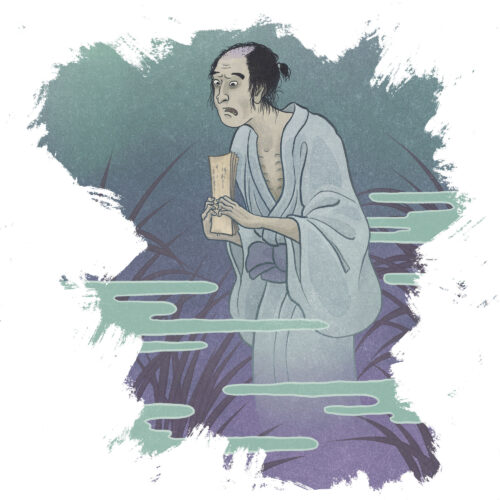
Tomotada thought, “What on earth is this?” and drew closer, but there was only a kosode with no trace of her form. He longed for the heavens and threw himself upon the earth in grief, but he could not even glimpse his departed wife in his dreams. At a loss as to what to do, he at last cut off his topknot and took up the life of a wandering ascetic.
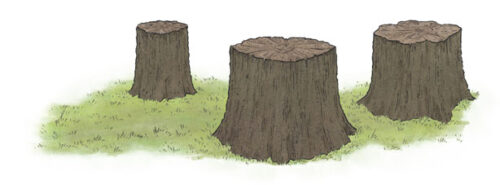
When he sought out his wife’s old home, he found no trace of the house or anything else. There were no neighbors that he could ask, and no one knew anything about his wife’s family. Only three large willow stumps remained. Without a doubt, he thought, “This must be them.” He built a burial mound beside them and, weeping bitterly, departed.